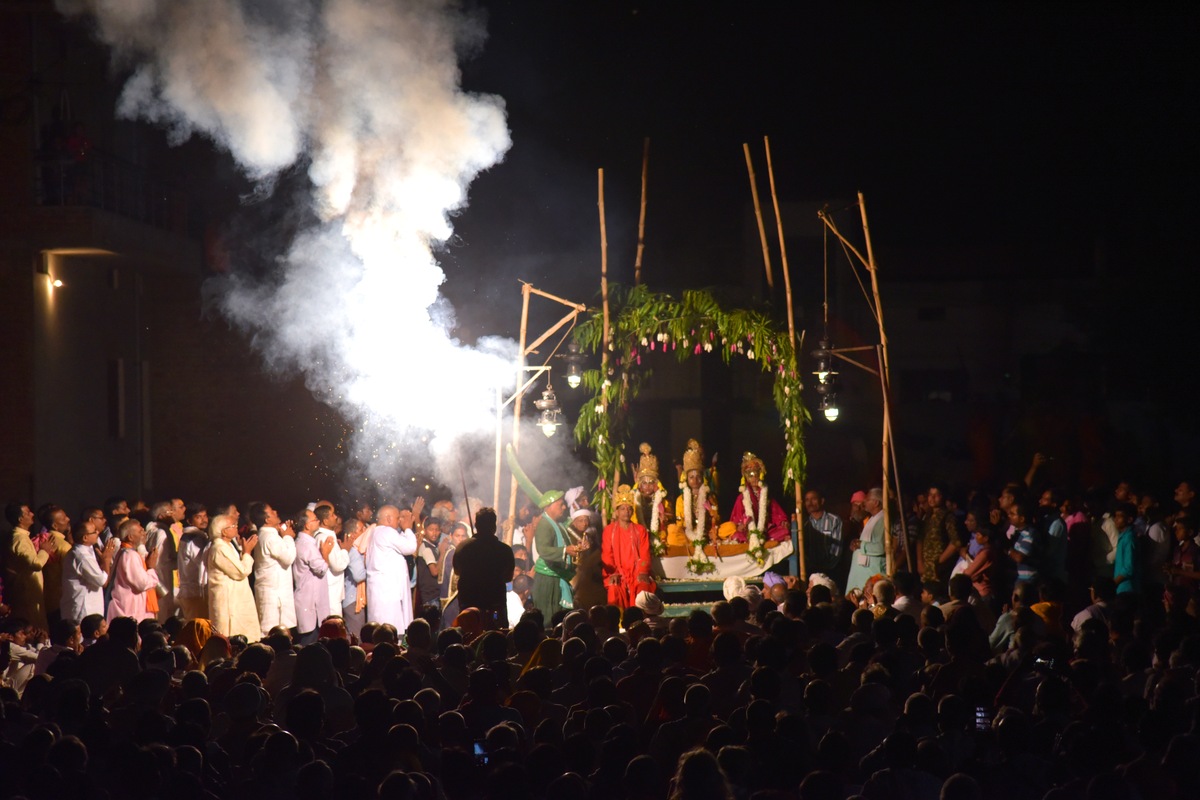
In Ramnagar’s Ramlila, spectators move with the performers between locations across the town. The Dussehra-season tradition turns fields, ponds and neighbourhoods into an extended performance space: the audience follows the epic’s journey rather than watching it unfold from one fixed seat.
The geography is deliberate. An account in the Indian Council for Cultural Relations’ journal Indian Horizons locates the performance’s Ayodhya near the fort entrance and Janakpur elsewhere in town. Ponds stand in for rivers; a grassy field becomes Panchavati; another area represents Lanka. These are places assigned roles within the performance, not claims that the epic’s actual locations sit next to each other in Ramnagar.
That arrangement gives travel a dramatic purpose. When Rama leaves home, the action leaves its earlier setting too. Familiar ground acquires a second meaning through the story being performed there. The audience has to make the journey between scenes, so exile, distance and return become changes in the space people occupy, as well as events they hear narrated. ICCR’s account describes this movement as a form of devotional participation.
Time expands alongside space. UNESCO says many Ramlila cycles last ten to twelve days, while Ramnagar’s can fill a month. The Indira Gandhi National Centre for the Arts documents a 31-day form in which spectators move with the actors and carry the Ramcharitmanas, following its verses alongside the performance. The book, the spoken dialogue and the changing locations work together rather than leaving the storytelling entirely to a stage set.
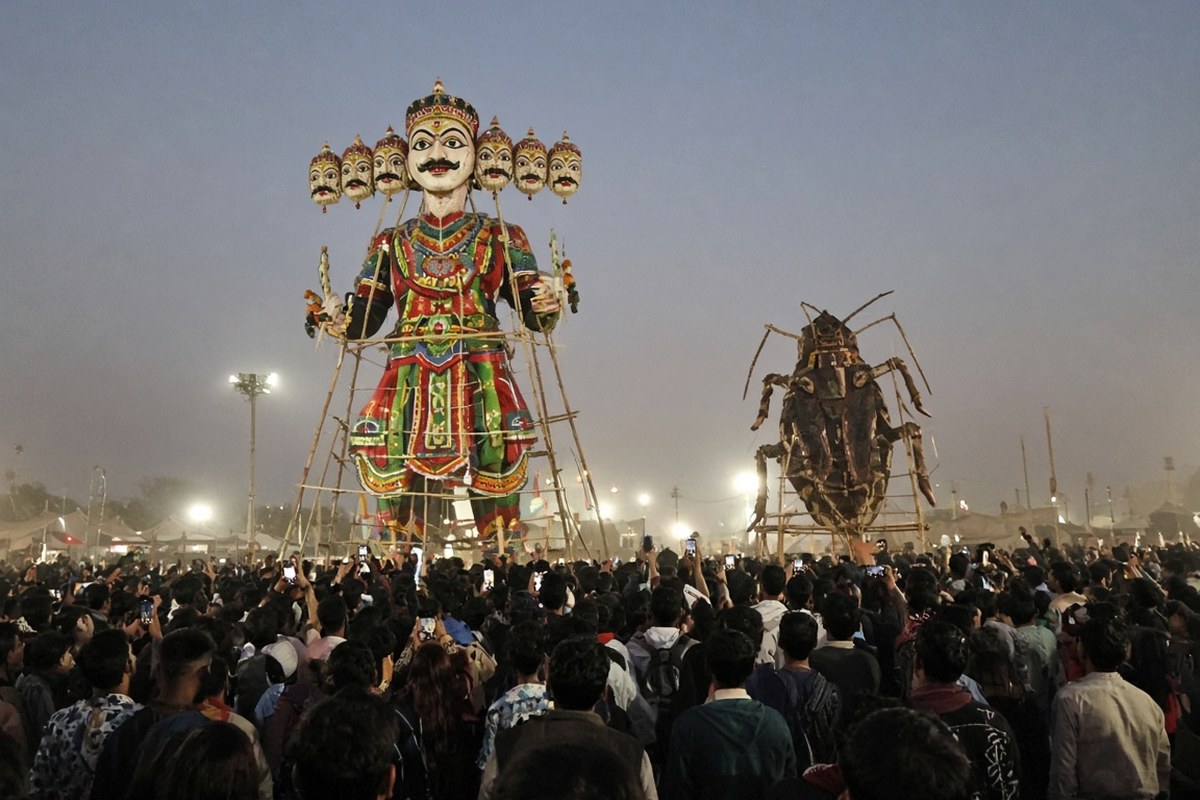
Ramlila also depends on people beyond its cast. UNESCO describes community participation in costumes, masks, make-up, effigies and lighting, as well as singing and narration. Its 2008 listing covers the broader Ramlila tradition, with Ramnagar among the prominent examples. In Ramnagar’s form, the audience’s movement is itself part of how that shared performance works.
More to read


Behind the story
Read the sources and explore the context for yourself.