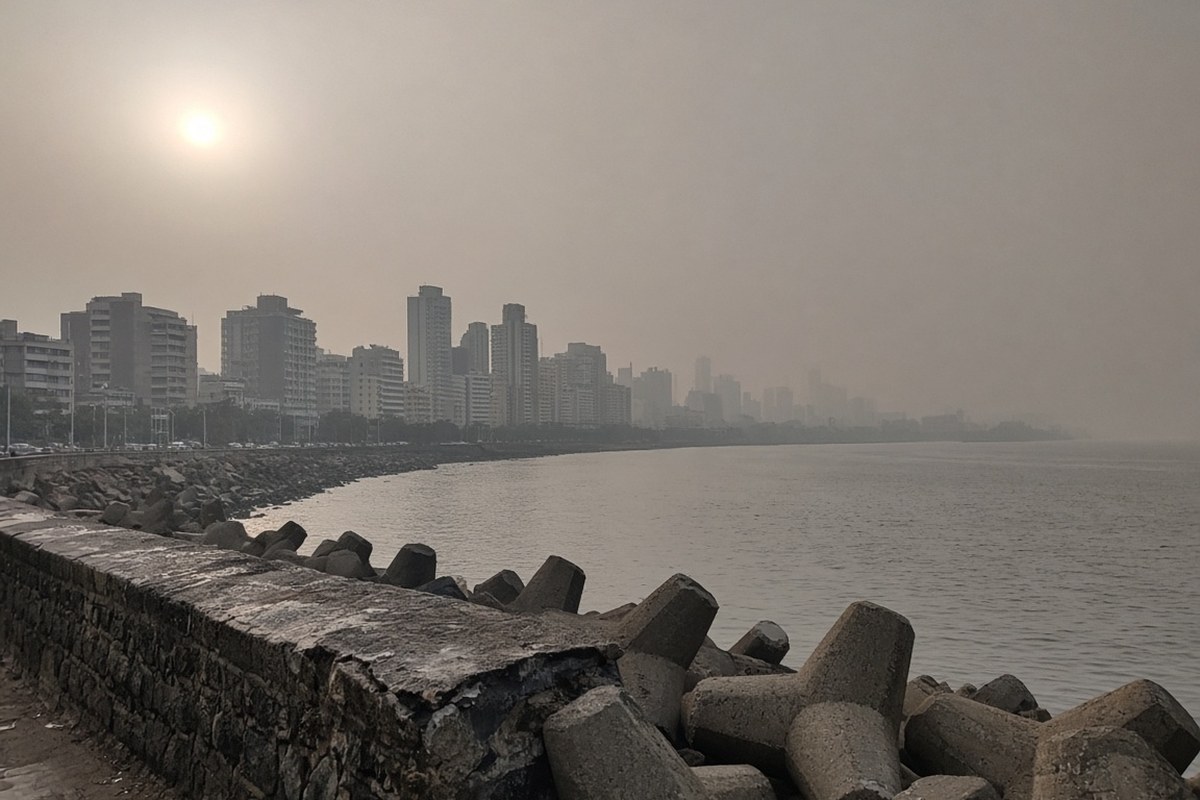
Mumbai is usually thought of as a city that breathes easier than Delhi, thanks to the sea breeze. This week that idea took a knock. On Wednesday, October 21, the Bombay High Court called the city’s smog an “emergency” and said it was “shocking” that Mumbai was surpassing Delhi in pollution levels, as The Indian Idiot reported. Here is what is going on.
How bad is it? On Wednesday, a day after Dussehra, the US-based monitor IQAir ranked Mumbai fourth among the world’s most polluted cities, with an air quality index (AQI) of 165, ahead of Delhi at 164. It named PM2.5, the fine particulate matter that can get deep into the lungs, as one of the main pollutants. The court noted that visibility in the city had dropped below 500 metres on Tuesday.
Why the numbers don’t match: The Central Pollution Control Board (CPCB) recorded a much lower AQI of 113 for Mumbai on Wednesday afternoon. The two use different methods. IQAir works with hourly averages, so a sudden spike shows up sooner, while the CPCB’s monitors measure air at fixed locations, civic officials told The Indian Express. IQAir also reports on the US AQI scale, which is not the same as India’s national index, so the figures cannot be compared one-to-one.
Smog in Mumbai after the monsoon is not new. When the rain withdraws, dust stays suspended in the air for longer. What is different this year is how early it started: the city’s AQI crossed 100 as early as October 2, The Indian Express reported.
The weather is a big part of it. Experts have linked the early, long spell of bad air to dry conditions associated with El Niño, which also brought an early withdrawal of the monsoon. Atmospheric scientist Gufran Beig of the National Institute of Advanced Studies has said that wind speeds over Mumbai have slowed sharply while it stays hot and humid, so pollutants settle in the lower atmosphere instead of being carried away.
Environmental scientist Tuhin Banerji pointed to another factor. “Furthermore, there is also NaCl from the sea, with these minute particles from the sea also getting absorbed in the atmosphere and floating around for much longer. There has been no relief and the air quality will further worsen in the week ahead,” he told The Indian Express.
Weather does not create the pollution, though; it only stops it from clearing. The sources are on the ground: dust from construction, excavation and demolition, vehicle exhaust and open waste burning. BMC officials have flagged construction sites as a major contributor, and festive firecrackers add to the load. “There might be pleasure for 15-20 minutes (in bursting crackers), but ultimately there will be more toxicity in the air,” Justice Girish Kulkarni said in court on Wednesday.
What can be done: Under the BMC’s standard operating procedure for the Graded Response Action Plan, issued in November 2025, the toughest curbs, including possible halts to construction, kick in if the city or local AQI stays above 200 for three days in a row, Hindustan Times reported. The High Court has asked the police, the BMC and the Maharashtra Pollution Control Board to report on enforcement, and will hear the case again on October 26.
More to read

Behind the story
Read the sources and explore the context for yourself.
- The Indian Idiot: Bombay High Court asks how officials can ‘have a peaceful sleep’ as Mumbai’s smog worsens (22 Oct 2026)theindianidiot.com
- The Indian Express: Mumbai smog surpassing Delhi an ‘emergency’, HC asks how officials can sleep (22 Oct 2026)indianexpress.com
- The Indian Express: Mumbai 4th most polluted city in world, air quality index 165 (21 Oct 2026)indianexpress.com
- The Financial Express: Why is Mumbai’s air worsening? (16 Oct 2026)financialexpress.com
- Moneycontrol: Mumbai air pollution explained: IQAir vs CPCB numbers, El Niño effect and BMC’s AQI-200 rule (21 Oct 2026)moneycontrol.com