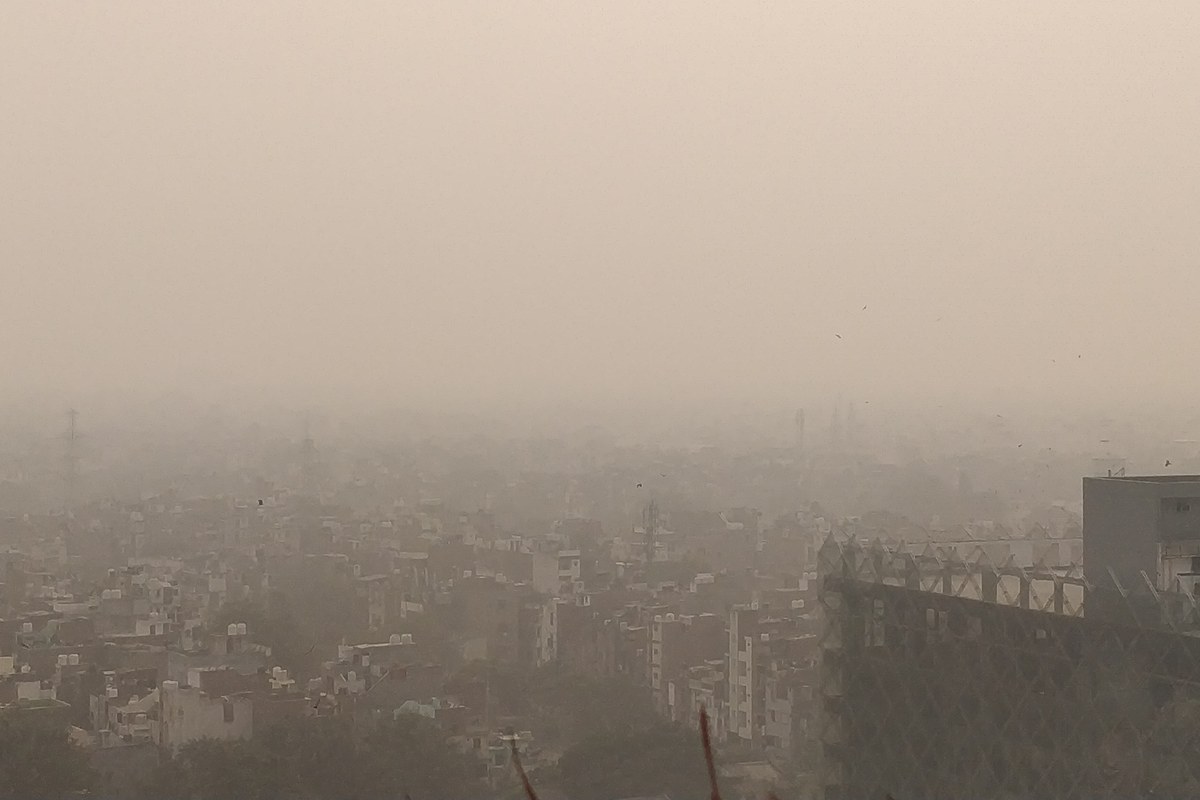
Dozens of Delhi's air monitoring stations stopped sending readings for fine dust, or PM2.5, in the hours when pollution peaked after Diwali, according to analyses by Hindustan Times, The Indian Express and The Times of India. The gaps came on Sunday night (8 November), after firecrackers were burst well past the Supreme Court's 10 pm deadline. The Central Pollution Control Board (CPCB) put Delhi's AQI at 370 at 9 am on Monday (9 November), in the “very poor” category.
Hindustan Times analysed CPCB's records for Delhi's 59 stations and found that 43 had a gap in PM2.5 between 10 pm and 6 am. At 14 of those 43, the last reading before the gap was 900 µg/m³ or more. The gaps affected stations run by CPCB, the Indian Institute of Tropical Meteorology (IITM) and the Delhi Pollution Control Committee (DPCC). At North Campus, PM2.5 climbed from 326 at 8 pm to 999 at 10 pm, and the next readings were blank.
Hindustan Times found that no PM2.5 reading from any Delhi station went past 1,000 µg/m³ this year, and the highest were exactly 1,000.0. Last Diwali, 29 of 39 comparable stations recorded at least one hour above 1,000. The newspaper said the pattern fits a limit at about 1,000 on the dust readings, and that why the limit exists and whether it is new are questions for CPCB. It said it had sent queries to CPCB. The Hindu reported that CPCB's public portal did not display PM2.5 readings above 1,000, citing CREA analyst Manoj Kumar.
Other readings show how high the air went. DPCC data cited by The Indian Express showed values from about 3,400 to nearly 5,000 µg/m³ at stations such as Mundka, Ashok Vihar, Punjabi Bagh and Jahangirpuri at the same hours CPCB's records had blanks. The Hindu reported 2,597 µg/m³ at Patparganj at 1 am, on DPCC's website. Separately, the Centre for Research on Energy and Clean Air (CREA) counted 227 missing hourly PM2.5 observations across 59 CPCB stations between midnight on 8 November and 5 am on 9 November, with only 14 stations reporting complete data, Kumar said.
What the blanks do to the official number is disputed. “When the hourly PM2.5 data is missing, it will artificially lower the Air Quality Index (AQI), showing better air quality, when the actual air quality is worse,” Kumar told The Hindu. Hindustan Times estimated Delhi's AQI for the 24 hours to 9 am at 437 using only recorded hours, and 471 with the blanks filled in by straight-line estimates, against CPCB's official 370. The newspaper said it had asked CPCB whether the blank hours were included in the official figure. The Indian Express reported, citing officials, that the gaps stemmed from software clipping on central servers and sensor stress during very high readings; DPCC stations also had gaps, though fewer.
The data gap has become a political row. AAP leader Saurabh Bharadwaj alleged “data fraud” by the Delhi government. Delhi minister Kapil Mishra said the government would look into the missing readings and alleged a “conspiracy” in AAP-run Punjab behind a spike in stubble-burning on Sunday evening. Neither claim has been independently verified. Delhi recorded its most polluted Diwali in five years, with an average AQI of 376, TOI reported.
As The Indian Idiot reported earlier, Delhi's air had already been worsening through the Diwali weekend.
More to read


Behind the story
Read the sources and explore the context for yourself.
- Hindustan Times: On Diwali night, Delhi's PM2.5 readings climbed towards 1,000, then went blank (9 Nov 2026)hindustantimes.com
- The Indian Express: As Delhi's air turned toxic on Diwali, 45 monitoring stations had missing readings (9 Nov 2026)indianexpress.com
- The Hindu: At peak of air pollution on Deepavali night, data goes missing at several govt monitoring stations in Delhi (9 Nov 2026)thehindu.com
- The Times of India: 'Data eclipse': Experts flag Delhi AQI data gap on Diwali night (9 Nov 2026)timesofindia.indiatimes.com
- The Indian Idiot: Delhi AQI 483 on Diwali morningtheindianidiot.com